

Research Spotlight: Ally Jacoby
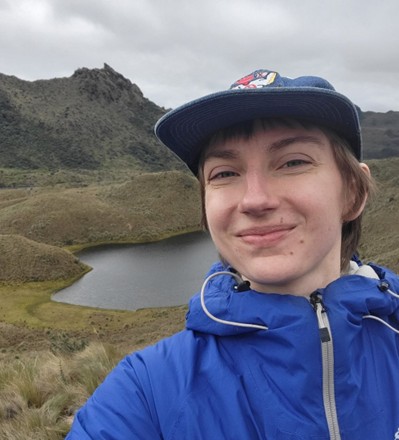
Welcome to our first early career research spotlight of 2026! Today we are highlighting Ally Jacoby, a PhD student at the University of Minnesota Twin Cities working in one of the most remote environments in the world: the tropical glaciers and páramo ecosystems of Ecuador. This unique region has thick peatlands that hold some of the highest carbon stocks in the world, and, despite lying near the equator, has mountains so tall that they bear glaciers. In fact, the equator runs directly through the Cayambe Volcano, the mountain that Ally focuses on in her work. Atop Cayambe Volcano sits the aptly-named Hermoso (“Beautiful”) Glacier, whose meltwaters Indigenous Andean communities living in the valleys of the volcano depend on for their water and way of life.
As global temperatures steadily rise under climate change, the Hermoso Glacier, which used to fill an entire glacial valley, has retreated upslope alarmingly fast — the canary in the coal mine for the devastating effects of climate change. Ecuador’s glaciers have lost an approximated 30-50% of their mass over the past few decades according to Ecuador’s National Institute of Meteorology and Hydrology (INAMHI). Ally Jacoby’s PhD thesis centers around studying the effects of this glacial retreat on the hydrology and carbon cycling of this fragile region — while working with Indigenous communities directly affected by this environmental injustice.

Ally in front of the Hermoso Glacier, the glacier on top of Volcán Cayambe which supplies vital water resources to downstream Indigenous agrarian communities. Only a couple of decades ago, within the lifetime of some Cayambe community members, the Hermoso Glacier used to fill the valley behind her.
Thank you for taking the time to share your experience with current early career researchers in hydrologic science! Could you introduce yourself and your research focus?
Hi! I’m Ally Jacoby, I’m a PhD candidate studying Hydrogeology at the University of Minnesota in the Earth and Environmental Sciences Department. I grew up in rural, northern Wisconsin and have always been drawn to waterways, spending many summer days canoeing and hanging out at the Namekagon River, which is a tributary of the St. Croix River, which is a tributary of the Mississippi River! I’m currently nearing the end of my PhD program, and when I’m not in the field or analyzing data, I like biking around Minneapolis, trying new coffee shops, and checking out local music. Throughout my PhD, I’ve been part of an interdisciplinary research team that is broadly interested in characterizing climate change impacts in the data-sparse glacierized tropics, particularly the downstream impacts of tropical glacier retreat. I quantify the hydrological and hydrochemical impact of glacier retreat and landcover change in a watershed located in the Ecuadorian Andes Mountains. I collaborate with scientists from across the U.S. and Ecuador, in addition to working with Indigenous Kichwa community partners in Ecuador.
How did you end up in the field of hydrology? What or who inspired you to be a scientist?
My initial interest in pursuing an advanced degree in environmental sciences was inspired by my environmentally-conscious parents, who have always done everything they can to reduce their carbon footprints. This, paired with my love for the waterways of the Midwest US, compelled me to pursue a bachelor’s degree in Environmental Science from Purdue University, with the ultimate goal of obtaining a career related to water conservation.
While completing my undergraduate degree, I was fortunate enough to be involved in research opportunities with a number of supportive mentors. For my first big research experience, I traveled to Peru as part of Purdue’s Discovery Undergraduate Interdisciplinary Research Internship (DUIRI), where my research project focused on identifying the presence of heavy metals in soils from a heavily-managed, arid agricultural site. While hydrology was not the focus of this project, this experience enabled me to learn about water resource management in a water-stressed environment, which reinforced my interest in hydrology.
When I began looking into graduate school programs, I was undecided about whether to pursue MS or PhD. However, I found a research profile of my now-PhD advisor, Dr. Crystal Ng, and her pursuit of ethical, community-driven science made me realize I wanted to follow a similar track and was ultimately why I decided on a PhD program.

Ally trekking to one of the discharge stations deployed in the base of the glacier by her research group.
You integrate both field sampling and numerical modeling into your PhD research. Which of those came first, and why did you ultimately decide to pursue both?
Tropical glaciers are unique and understudied compared to their higher latitude counterparts, so one of the motivations for conducting research in the tropical glacierized Andes was to increase hydrometeorological monitoring in a data-sparse region. Our research team started out by collecting continuous records of meteorological and hydrologic variables, and these data have been helpful in developing a baseline understanding of the drivers of streamflow and solute export in this region.
In my research, I explore land cover change impacts on a small, partially glacierized headwater catchment, where glacier melt is a major contributor to streamflow. I use the multi-year hydrometeorological data collected by our team to constrain a numerical watershed model called Flux-PIHM, which represents the physics governing water fluxes across a landscape. Using this model, I simulate the major processes controlling streamflow generation so that the model-simulated streamflow matches our present-day field observations. Upon validating the model, I test catchment-level changes in meteorology and landcover to predict how streamflow dynamics would respond to potential future land cover distributions or conditions driven by climate change.
So in summary, both the field data collection and numerical modeling are important and interrelated: the field monitoring helps characterize the ecosystem in the present-day and constrain the numerical model results, and the numerical model helps explain the physical processes driving our environmental observations and can be used as a tool for predicting streamflow response to environmental change.

Measuring water temperature, pH, and electrical conductivity in one of the fingers of melt gushing from beneath Hermoso Glacier. These tiny streams hold the water that sustains downstream Kichwa communities, buffering their water resources during periods of low precipitation.
How has working with Andean Indigenous communities impacted your research and awareness of social issues in the hydrology community/to water access generally? How do you think you will take the lessons you learned in your PhD into your future career?
Spending time in Ecuador has underscored to me that the effects of climate and environmental change are intersectional. On a national scale, I’ve observed Indigenous communities across Ecuador continually lead the fight for environmental protections, from the Amazon to the Andes, while also facing some of the most immediate consequences of resource extraction and climate change. Our research team collaborates closely with Kichwa communities, and they remind me that environmental change is a multi-faceted issue that impacts not only the physical environment but is also tied to change and loss in culture, languages, and ways of life.
Working with our community partners has solidified my interest in pursuing community-centered environmental research in my future career. The project that I’m currently part of has been a wonderful example of community-driven research based in trust and respect for people and the environment. I’ve learned that conducting ethical environmental research (particularly when it is fieldwork-based) must be predicated on the establishment of intentional relationships between academic and community partners prior to starting fieldwork in a given setting. Part of the relationship-building process includes holding ongoing conversations between the visiting academic team and community members to continuously assess the expectations and constraints for the research methodologies and outcomes, which ensures that a reciprocal relationship is maintained. Our team has worked closely with our community partners to develop culturally-informed research protocols, which guide our actions when visiting their lands, handling data, and communicating results back to community partners. I’ve found that honoring relationships within a research collaboration strengthens the scientific outcomes while also increasing the societal impact of the work by grounding the research in the lived-experiences of local communities.

Working with Kichwa community members to download data from one of the many sensors deployed around the watershed. Ally and her advisor, Dr. Crystal Ng, are part of the interdisciplinary research team that has collected the first on-the-ground measurements of temperature, precipitation, and solar radiation in Cayambe in partnership with local community members.
If you had to soap box to the hydrology community about any issue in hydrology/environmental justice, what would you say?
Throughout graduate school, I’ve become increasingly aware of the colonial histories behind the field of geology and land-grant institutions. I’ve come to realize that geoscience curricula and university messaging often rely on revisionist histories that omit the role that both geologic mapping/extraction and the Morrill Act of 1862 (which allocated millions of acres of land to establish land-grant universities across the United States) played in the dispossession of Indigenous lands through coercion and violence. Becoming aware of these histories has highlighted for me the importance of reflecting upon one’s own positionality within an institution. As scientists, we should ask ourselves, “How do I fit into the context/history of my institution and the land I work upon, and how may I be unintentionally perpetuating colonialism in my research or teaching?”. Personally, I’ve learned a lot from the TRUTH (Towards Recognition and University-Tribal Healing) Report, a collaborative research report led by the 11 federally recognized tribes in present-day Minnesota, which details the erased histories of tribal-university relations and outlines recommendations for how the University of Minnesota can be in better relation with Indigenous peoples moving forward.
As hydrologists, our work is inextricably linked to land and people, and therefore I feel that it is our responsibility to learn the history of our institutions and our field sites as a first step in approaching research from an environmental justice-centered framework. For this reason, I encourage all scientists to learn and reflect upon the unique histories of their own institutions and communities.


https://gamebaidoithuong.capital/ban-ca/ là một trang tổng hợp top 10 bắn cá online theo tháng 9/2026, mở ra là thấy tiêu đề “top 10” nằm ngay trên đầu nên khỏi phải đoán họ đang nói gì. Mình lướt kiểu người dùng bình thường thôi, và thích cái cách họ chia nội dung thành từng khối ngắn, đọc vài dòng là nắm được ý chính chứ không bị ngợp bởi đoạn dài. Có chỗ ghi khá cụ thể kiểu số phòng săn cá với mức đạn dao động rộng, nhìn qua là hình dung được game nhắm tới cả tân thủ lẫn ai thích bắn mạnh tay. Nói chung kéo trang cũng nhẹ nhàng. Phần tiêu đề và các hộp thông tin tách…
TẢI SUNWIN lúc đầu mình hơi nghi nghi, kiểu tiêu đề “trang chủ chính thức không bị chặn… 2026” nghe cứ như đang kể chuyện hành lang trên mạng ấy, nên mình bấm vào xem thử cho biết chứ cũng không kỳ vọng gì nhiều. Ai ngờ vào rồi lại thấy khá dễ chịu, vì họ trình bày theo từng khối thông tin tách bạch nên lướt một mạch vẫn theo kịp, không phải căng mắt dò từng dòng. Mình cũng thích cái cách họ để menu ở vị trí dễ nhìn, bấm qua lại vài lần mà không bị rối (đỡ phải đoán xem nút nào dẫn đi đâu). Nói chung không phải kiểu trang làm màu, nhìn là…
AE888.CAT mình ghé thử mấy phút vì thấy bạn bè nhắc, kiểu vào xem giao diện ra sao thôi. Ấn tượng đầu là bố cục chia khu nhìn dễ hiểu, kéo xuống không bị rối mắt, mấy khối nội dung tách ra rõ nên lướt nhanh vẫn nắm được ý chính. Mình có để ý họ có nhắc kho giải trí hơn 100 lựa chọn, nhưng cách trình bày không làm mình “ngợp”, nhìn vẫn gọn gàng. Với ai hay để ý tính minh bạch thì phần giấy tờ chứng nhận pháp lý họ để riêng, có mã số với thời hạn nhìn khá rõ ràng. Nói chung dùng kiểu “xem cho biết” mà vẫn thấy ổn vì menu nằm…
https://uu88bs.app/ mình mới ghé thử lúc rảnh vì thấy mọi người nhắc, kiểu vào xem cho biết thôi. Cảm giác đầu tiên là giao diện nhìn khá hiện đại mà không bị “lòe loẹt”, tông màu trung tính nên ngồi lướt một hồi vẫn ổn mắt. Mình cũng để ý mấy mục trên trang chủ được chia theo từng khối rõ ràng, bấm qua lại dễ hiểu chứ không bị rối. Thông tin họ để vừa phải, không nhét chữ kín màn hình nên đọc nhanh vẫn nắm được ý. Nói chung trải nghiệm kiểu nhẹ nhàng, không phải dạng trang mở ra là choáng vì quá nhiều thứ. Mình thích nhất cách các danh mục trên trang chủ được…
rr88 lúc đầu mình cũng hơi nghi ngại vì mấy trang kiểu này hay bày biện rối mắt, nhưng vào thử trang chủ thì thấy họ làm bố cục khá “thở”, nhìn một cái là biết đang ở đâu. Mình chỉ lướt nhẹ thôi mà kéo xuống vẫn theo nhịp, từng khối nội dung xếp ngay hàng chứ không quăng chữ lung tung nên đọc đỡ mệt, nhất là với người dễ mất tập trung như mình. Có đoạn họ ghi nền tảng hoạt động từ 2018 và đặt trụ sở ở Philippines, thông tin kiểu này đọc qua thấy ít nhất họ cũng chịu ghi rõ mốc chứ không nói chung chung cho xong. Menu để chỗ dễ thấy.…